Key Takeaways
- Improve Your Body Awareness: Weighted vests enhance proprioception, your body’s ability to sense its position, which is crucial for balance.
- Strengthen Your Core and Legs: The added resistance strengthens the key stabilizer muscles in your hips, core, and legs that prevent falls.
- Better Posture, Better Balance: The vest encourages a more upright posture, creating a more stable base of support.
- Start with Balance-Focused Exercises: Incorporate exercises like the single-leg stance and heel-to-toe walk to specifically target your balance systems.
- Safety First: Always perform balance exercises near a wall or sturdy chair for support, especially when you are starting out.
Introduction
For older adults, maintaining balance is not just about preventing falls—it’s about preserving independence and quality of life. As we age, a combination of factors, including muscle weakness and a decline in our sense of body position (proprioception), can make us more susceptible to falls. Weighted vests, often associated with high-intensity training, are now being recognized as a powerful tool for improving balance and stability in seniors.
This article delves into the science behind how weighted vests can enhance balance and reduce the risk of falls. We will explore the key mechanisms at play, from strengthening stabilizer muscles to improving proprioceptive feedback. Additionally, we will provide a series of targeted exercises that can be performed with a weighted vest to specifically challenge and improve your balance. Before starting, please consult with your healthcare provider to ensure this type of training is appropriate for you.
The Science: How Weighted Vests Improve Balance
Several interconnected mechanisms explain why weighted vests are so effective at improving balance in older adults:
1. Enhanced Proprioception
Proprioception is your body’s ability to sense its position and movement in space. This sense relies on receptors in your muscles, tendons, and joints. As we age, proprioceptive function naturally declines, contributing to balance problems. A weighted vest provides additional sensory input to these receptors, essentially “waking them up” and improving your awareness of your body’s position. This heightened awareness translates to better balance and coordination.
2. Strengthening Stabilizer Muscles
Balance is not just about having strong legs—it’s about having strong stabilizer muscles throughout your entire body. These muscles, including those in your core, hips, and ankles, work constantly to keep you upright and stable. A weighted vest adds resistance to your movements, forcing these stabilizer muscles to work harder. Over time, this leads to increased strength and improved stability.
3. Improved Postural Control
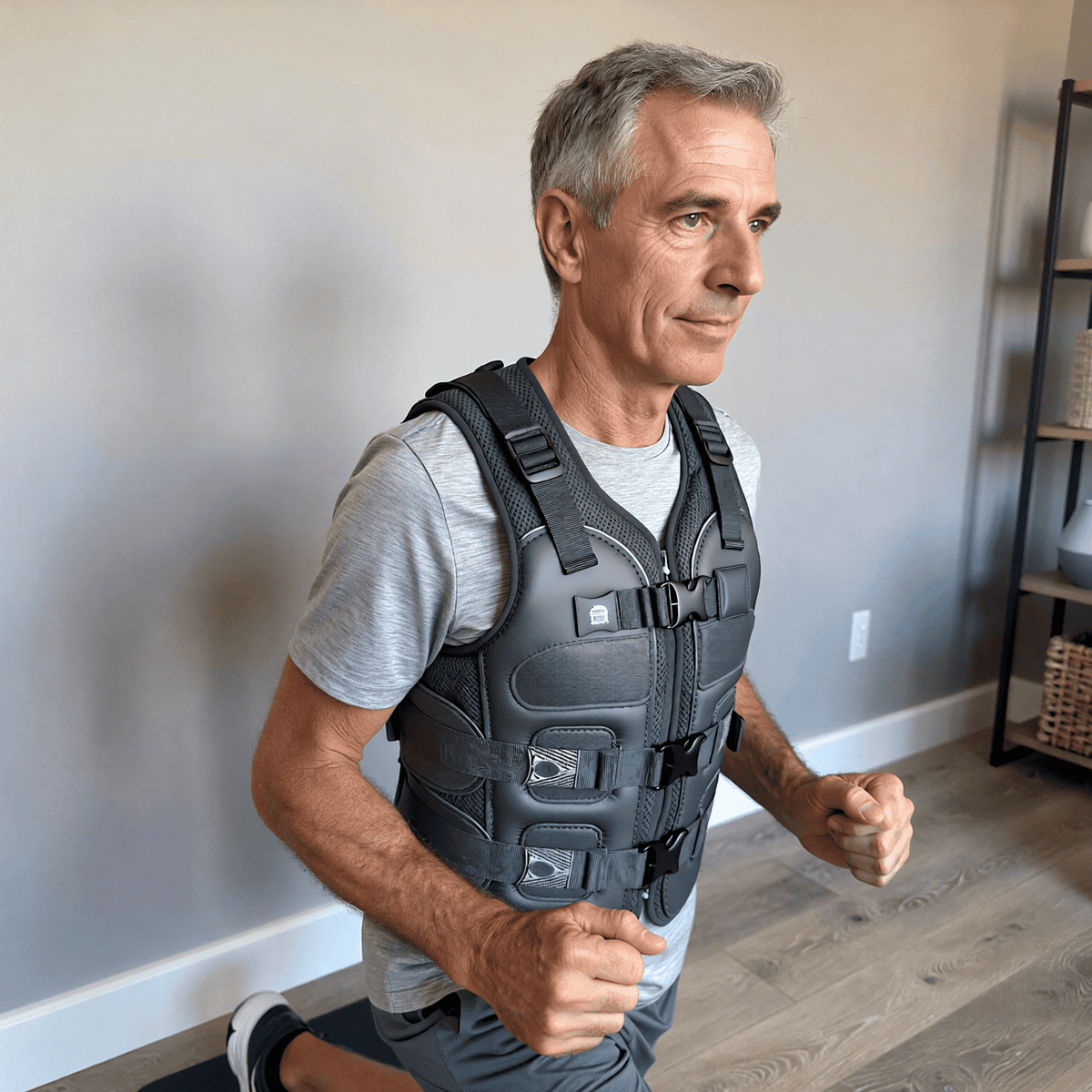
Poor posture can significantly impact balance. A weighted vest encourages a more upright posture by gently pulling your torso forward. This forces your postural muscles to engage and maintain proper alignment. Better posture means a more stable base of support and a reduced risk of falls.
4. Increased Ground Reaction Forces
When you walk or move with a weighted vest, the force exerted on the ground with each step is greater. This increased force sends stronger signals to your brain about your body’s position and movement. Your brain uses this information to make constant adjustments to maintain balance.
Balance-Focused Weighted Vest Exercises for Seniors
These exercises are specifically designed to challenge and improve your balance. Start with the easier variations and progress to the more challenging ones as you get stronger and more confident. Always perform these exercises near a wall or sturdy chair for support if needed.
Single-Leg Stance
- Duration: Hold for 20-30 seconds per leg
- How-to: Stand tall with your feet together. Lift one foot slightly off the ground, keeping your knee bent. Hold this position for the recommended time, then switch legs. To make it easier, hold onto a chair or wall. To make it harder, close your eyes.
Heel-to-Toe Walk:
- Reps: Walk for 10-15 steps
- How-to: Walk in a straight line, placing the heel of one foot directly in front of the toes of the other foot with each step. Imagine you are walking on a tightrope. Use a wall for support if needed.
Side Leg Raises:
- Reps: 10-12 per leg
- How-to: Stand tall, holding onto a chair or wall for support. Slowly lift one leg out to the side, keeping your knee straight. Hold for a moment, then lower it back down. Repeat on the other side.
Clock Reaches:
- Reps: 8-10 per leg
- How-to: Stand on one leg. Imagine you are standing in the center of a clock. Reach your free leg forward (12 o’clock), to the side (3 o’clock), and behind you (6 o’clock). Lightly tap the ground with your toe at each position. Repeat on the other leg.
Tandem Stance:
- Duration: Hold for 20-30 seconds
- How-to: Stand with one foot directly in front of the other, heel to toe. Hold this position for the recommended time, then switch the position of your feet. This is a challenging exercise, so use a wall or chair for support if needed.
Conclusion
Weighted vests offer a safe and effective way for seniors to improve their balance and reduce their risk of falls. By enhancing proprioception, strengthening stabilizer muscles, and improving postural control, weighted vest training can have a profound impact on your stability and confidence. Incorporate the exercises outlined in this article into your routine 2-3 times per week, and you will be well on your way to better balance and a more active, independent life. Remember to always prioritize safety and consult with your healthcare provider before starting any new exercise program.
Frequently Asked Questions (FAQs)
How heavy should my vest be for balance training?
For balance-focused exercises, a very light vest is all you need. A weight of 1-3% of your body weight is sufficient. The goal is to provide sensory feedback and gentle resistance, not to build bulk muscle.
Can I do these balance exercises every day?
Yes, unlike heavy strength training, light balance exercises can often be performed daily. They are low-impact and focus on neuromuscular coordination. Listen to your body, and if you feel any strain, take a rest day.
I have a fear of falling. How can I start safely?
It’s essential to start in a safe environment. Hold onto a sturdy chair, a countertop, or stand in a corner where you have walls on both sides for support. Never perform balance exercises in an open area where you could fall and injure yourself. As you get more confident, you can gradually reduce your reliance on support.
How long will it take to see improvements in my balance?
With consistent practice (3-5 times per week), many seniors notice improvements in their stability and confidence within a few weeks. However, significant, lasting changes in balance and fall reduction are typically seen after 2-3 months of regular training.
Can a weighted vest help if I use a cane or walker?
Yes, it can still be beneficial. The added weight can help improve your posture and strengthen your core and upper body, which is important for controlling a walker or cane. It can also enhance the sensory feedback you get through your feet. However, you must discuss this with your physical therapist to ensure it is integrated safely with your mobility aid.