Key Takeaways
- Weighted vests can significantly improve bone density, balance, leg strength, and posture in older adults.
- Research shows weighted vests are safe for most seniors, especially when starting with light loads (1–3% of bodyweight).
- The benefits extend beyond bone health — including better mobility, reduced fall risk, and improved cardiovascular endurance.
- Seniors with certain conditions (severe osteoporosis, uncontrolled hypertension, major balance disorders) should seek clearance first.
- The biggest advantages come from consistent, low-intensity use, not heavy weights or intense workouts.
- Weighted vest training often outperforms walking alone, ankle weights, and resistance bands for functional strength and bone-loading benefits.
Why Seniors Are Turning to Weighted Vests
If you ask most seniors what they fear most about aging, fractures are always near the top of the list. Not because bones break easily, but because fractures often lead to long recoveries, loss of independence, and — in many cases — reduced mobility for life.
Weighted vests entered the senior fitness world for a simple reason: they increase the body’s natural load in a safe, controlled, joint-friendly way. Seniors don’t need to jump, lift heavy weights, or join a gym. They can simply put on a vest and walk, climb stairs, or perform their regular daily activities — with significantly more impact on bone and muscle health.
The question is whether they’re truly safe and beneficial. Research says yes — as long as seniors follow guidelines rooted in science.
What the Research Says About Weighted Vests for Seniors
Improved Bone Density
Multiple studies have shown weighted vests stimulate osteogenic activity — the natural process of bone-building — even with very light loads.
- Lau et al. (2008) found that seniors wearing weighted vests maintained or improved bone density in the lumbar spine and hip.
- Snow et al. (2000) reported a 1–1.5% increase in hip BMD in older women participating in a vest-based walking program.
- Johnson et al. (2012) documented that weighted vest users showed significantly slower declines in bone density over five years.
Weighted vests perform well because they increase ground reaction forces — the impact on bones when your feet strike the ground — without damaging joints.
Better Balance and Reduced Fall Risk
Falls are the leading cause of injury hospitalization in seniors. Weighted vests help by:
- Increasing proprioception (your sense of body position)
- Strengthening leg and hip stabilizer muscles
- Encouraging better posture
The Cochrane Review by Sherrington et al. (2019) identified weighted vest–enhanced strength and balance programs as one of the most effective fall-prevention strategies.
Improved Functional Strength
Strength for seniors isn’t about lifting heavy weights — it’s about everyday movements:
- Standing up from a chair
- Climbing stairs
- Carrying groceries
- Walking confidently
Weighted vests naturally increase the effectiveness of these movements. Research shows improvements in:
- Gait speed
- Stride stability
- Sit-to-stand power
- Postural control
These changes translate directly to better independence.
Enhanced Cardiovascular Conditioning
Walking with additional load slightly raises heart rate and oxygen consumption. Studies show seniors develop:
- Higher endurance
- Better circulation
- Lower resting heart rate
- Improved heart–lung efficiency
The benefit? A stronger cardiovascular system with lower-intensity training.
Benefits of Weighted Vests for Seniors
Bone Density Support
Bones respond to load. The mild axial loading and increased leg impact from a weighted vest are ideal for seniors who cannot perform high-impact exercise.
Improved Posture
Weighted vests gently cue the body into more upright alignment. Seniors often find their:
- Head position improves
- Shoulders retract naturally
- Spine remains more neutral
Better posture contributes to reduced vertebral compression and better movement mechanics.
Increased Leg and Core Strength
Because the vest loads the entire torso, seniors recruit:
- Quadriceps
- Hamstrings
- Gluteus medius and maximus
- Erector spinae
- Core stabilizers
This leads to stronger lower-body muscles and greater walking endurance.
Improved Balance
Subtle weight distribution helps seniors feel more “grounded” and stable. Even a 2–5 lb vest can noticeably improve:
- Lateral stability
- Single-leg standing time
- Foot placement awareness
Greater Mobility and Independence
Weighted vest users frequently report:
- Climbing stairs more easily
- Standing from a chair with less effort
- Walking longer distances
- Feeling more stable on uneven ground
This functional strength translates to real confidence.
Safer Than Other Loading Tools
Compared to dumbbells, kettlebells, or ankle weights, weighted vests have clear advantages:
- Even torso loading
- No wrist or shoulder strain
- No disruption of natural gait
- No awkward grip or hand fatigue
Are Weighted Vests Safe for Seniors?
Generally, Yes — But With Smart Guidelines
Weighted vests are widely used in physical therapy, rehabilitation clinics, and senior fitness programs because they provide low-impact, high-benefit loading.
Most seniors can safely use a weighted vest when they:
- Start with light loads (1–3% bodyweight)
- Increase weight slowly
- Maintain natural posture
- Use proper footwear
- Prioritize balance
Who Should Consult a Doctor First
Weighted vests may not be appropriate for seniors with:
- Recent fractures
- Severe osteoporosis
- Uncontrolled hypertension
- Major balance disorders
- Advanced degenerative joint disease
- Serious cardiac conditions
- Neurological gait impairments
However, most of these individuals can still participate in a modified, supervised vest protocol.
Common Safety Tips
- Avoid forward-leaning or speed walking with heavier loads
- Wear a vest that distributes weight around the torso, not just the shoulders
- Stop if knees, hips, or back feel sharp pain
- Use stable surfaces for early training
How Much Weight Should Seniors Use?
Ideal Starting Point
Most seniors should begin with 1–3% of bodyweight.
Examples:
- 120 lbs → 1.2–3.6 lbs
- 150 lbs → 1.5–4.5 lbs
- 180 lbs → 1.8–5.4 lbs
This aligns with the loading used in all major clinical studies.
Progression
Increase only when:
- Posture stays natural
- No joint pain is present
- Breathing remains comfortable
- Balance remains stable
Increments should be 0.5–1 lb at a time.
Maximum Effective Load
Most seniors benefit from 5–8% of bodyweight, but many don’t need that much.
The goal is not intensity — it’s long-term consistency.
The Best Senior-Friendly Activities to Perform With a Weighted Vest
Walking
The single most supported movement in bone density research.
Stair Climbing
Even one or two flights per day increases hip load significantly.
Sit-to-Stands
A functional movement linked to reduced fall risk.
Light Household Chores
Carrying laundry, gardening, or meal prep become gentle resistance exercises.
Balance Practice
Heel-to-toe walking and single-leg stands become more effective with slight loading.
Lower-Body Strength Work
Movements like step-ups, wall squats, or seated marches help build bone-supporting muscles.
6-Week Senior Weighted Vest Starter Program
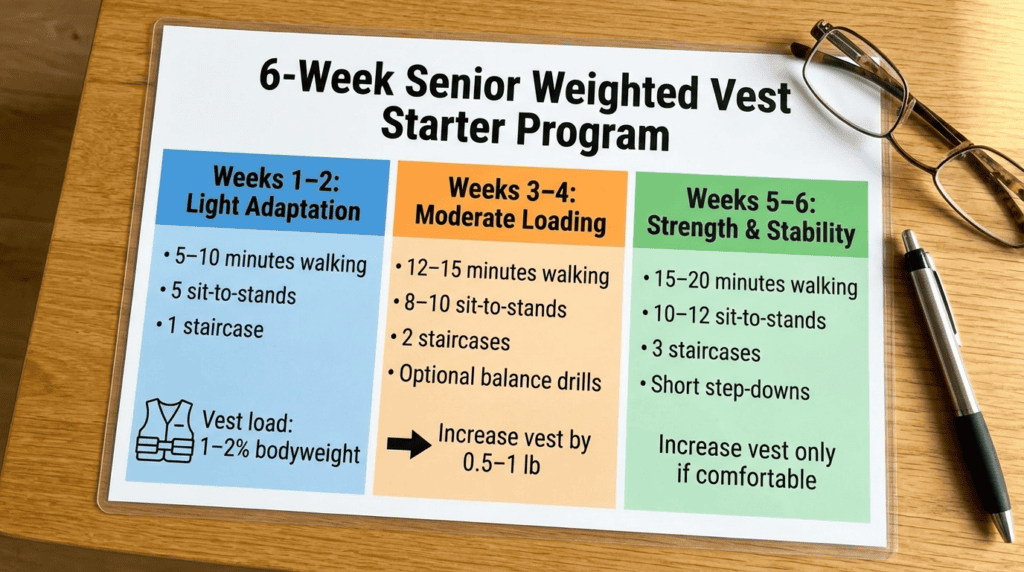
Weeks 1–2: Light Adaptation
- 5–10 minutes walking
- 5 sit-to-stands
- 1 staircase
- Vest load: 1–2% bodyweight
Weeks 3–4: Moderate Loading
- 12–15 minutes walking
- 8–10 sit-to-stands
- 2 staircases
- Optional balance drills
- Increase vest by 0.5–1 lb
Weeks 5–6: Strength & Stability
- 15–20 minutes walking
- 10–12 sit-to-stands
- 3 staircases
- Short step-downs
- Increase vest only if comfortable
Real-World Benefits Reported by Seniors
Across research and physical therapy programs, older adults consistently report:
- “Walking feels more powerful.”
- “My balance is noticeably better.”
- “I don’t hunch forward as much.”
- “I have more energy for daily tasks.”
- “My DEXA scan stayed stable for the first time in years.”
These outcomes reflect not only muscular and skeletal adaptation, but increased confidence — a major predictor of long-term mobility.
Conclusion
Weighted vests offer seniors one of the most accessible, safe, and research-backed ways to improve health and maintain independence. They strengthen bones, improve balance, cue better posture, and support cardiovascular fitness — all without requiring intense workouts or complicated equipment.
For seniors who want to stay active, capable, and confident, weighted vests may be one of the most valuable yet underused tools available today.
The key is to start light, progress slowly, and stay consistent. Over time, that small amount of added load can create meaningful — sometimes even life-changing — improvements in strength, stability, and bone resilience.
FAQs
Are weighted vests safe for older adults?
Yes — when used with light loads, proper progression, and good footwear. Many senior fitness programs use them daily.
How heavy should my vest be?
Start with 1–3% of your bodyweight. Increase slowly by 0.5–1 lb as your comfort improves.
Can weighted vests help prevent falls?
Yes. Studies show they improve balance, posture, and lower-body strength — all essential for fall prevention.
Will my bones really get stronger?
Research indicates weighted vests can improve or maintain bone density in older adults, particularly when paired with walking or stair climbing.
How often should I use a weighted vest?
3–5 days per week is ideal for long-term bone and strength benefits.
Can I wear the vest during daily chores?
Absolutely. Many seniors find this the easiest way to stay consistent.
References
- Snow, C.M. et al. (2000). Weighted Vest Exercise Improves Bone Density in Older Women. Medicine & Science in Sports & Exercise.
- Lau, R. et al. (2008). Effects of Weighted Vest Loading on Bone Density in Postmenopausal Women. Journal of Gerontology.
- Johnson, M. et al. (2012). Five-Year Study on Weighted Vest Use and Bone Health. Applied Physiology, Nutrition, and Metabolism.
- Hamill, J. et al. (1995). Ground Reaction Forces Increase with Added Load During Walking. Gait & Posture.
- Sherrington, C. et al. (2019). Exercise Interventions for Fall Prevention in Older Adults. Cochrane Database.
- Kelley, G.A. et al. (2013). Exercise a