Key Takeaways: Weighted Vests For Seniors
- Research on older adults shows weighted vests can maintain or improve bone density, especially in the hip and spine.
- The most effective loading range for seniors is 1–3% of bodyweight to start, gradually increasing to 5–8% if tolerated.
- Weighted vests increase ground reaction forces, stimulate osteoblast activity, improve posture, and enhance balance — all of which support bone health.
- Seniors who walk with a weighted vest show better bone outcomes than those who walk without one.
- Weighted vests are safer than ankle/wrist weights because they distribute load evenly across the torso.
- Consistency (3–5 days per week) is more important than heavy loading.
- Seniors with severe osteoporosis, uncontrolled cardiovascular conditions, or balance disorders should seek medical clearance before beginning.
Why Bone Density Declines With Age
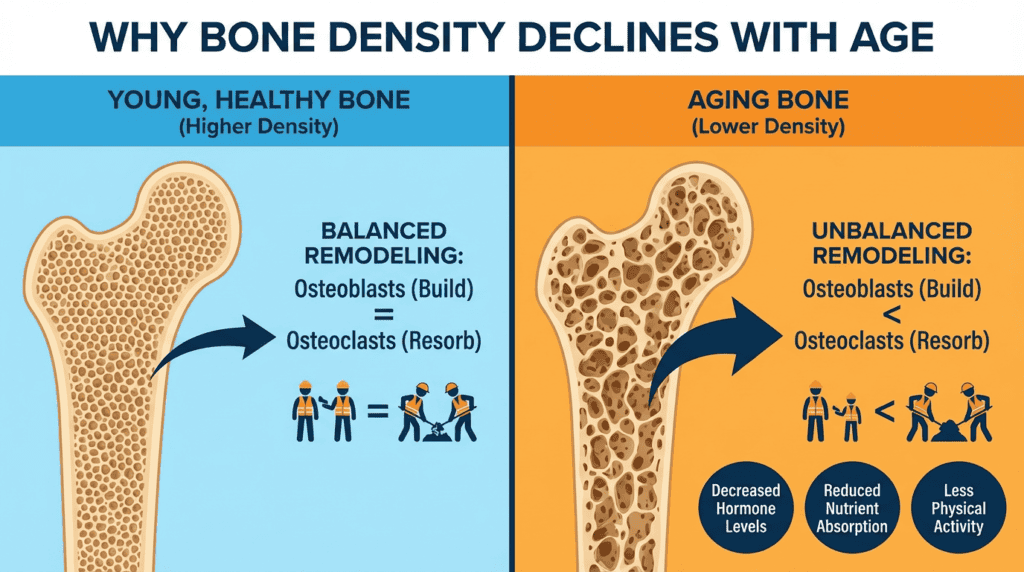
Most seniors don’t notice bone loss happening — there’s no pain, no obvious warning sign, nothing noticeable day-to-day. But beneath the surface, bone cells gradually become less active. After age 50, adults lose 0.5–1% of bone mass per year, and postmenopausal women may lose up to 3% annually for several years.
Bone is living tissue that adapts to demand. When the demand (mechanical load) drops — often because walking becomes gentler, movements become slower, or strength exercises decrease — bone-building cells (osteoblasts) don’t receive the signals they need to stay active. That’s when density drops.
Weighted vests for seniors have entered the conversation because they offer something uniquely effective: they increase load without increasing joint stress, making them ideal for seniors who can’t perform high-impact exercise.
The Science Behind Weighted Vests for Bone Density
Over the past two decades, researchers have conducted multiple controlled trials examining the effects of adding external weight to walking, stair climbing, and daily movement. What they found is surprisingly consistent.
Key Finding 1: Light Loading Stimulates Osteogenesis
In the groundbreaking Lau et al. (2008) study, postmenopausal women wore a weighted vest during daily activities and low-impact exercise. Those who used the vest:
- Improved lumbar spine bone density
- Maintained hip density while the control group lost density
- Reported increased leg strength and balance
This study demonstrated something that still surprises seniors today: bones respond strongly to small, consistent increases in load.
Key Finding 2: Weighted Vests for Seniors- Outperform Walking Alone
Traditional walking is wonderful for heart health — but its bone-building effects are minimal because the load doesn’t change.
However, in the Snow et al. (2000) trial:
- Femoral neck BMD increased by 1.5%
- Trochanter BMD increased by 1.4%
- Lumbar spine density stabilized
All from simple, regular movement wearing a vest.
In contrast, walking without load rarely produces measurable bone changes in older adults.
Key Finding 3: Long-Term Vest Use Slows Age-Related Bone Loss
In a five-year longitudinal study (Johnson et al., 2012), older women who used weighted vests during resistance and functional movements maintained bone density in key fracture sites while the control group lost bone.
The authors noted that adherence — not age — predicted the degree of benefit.
How Weighted Vests For Seniors Stimulate Stronger Bones
Let’s break down why this tool works so well for seniors:
1. Increased Ground Reaction Forces
Every time your foot strikes the ground, a small force travels upward through your leg bones and spine.
Adding even 5% of bodyweight, as shown in Hamill et al. (1995), increases these forces significantly.
This is exactly the type of mechanical stimulus osteoblasts respond to.
2. Axial Loading of the Spine
Weighted vests gently compress the spine — not in a harmful way, but in a way that encourages bone turnover.
3. Improved Muscle Recruitment
Stronger muscles pull harder on bones, which signals bones to strengthen. Weighted vests increase engagement in:
- Glutes
- Quadriceps
- Hamstrings
- Core musculature
4. Better Proprioception and Posture
Seniors often report feeling “more upright” or “more grounded.”
Improved posture reduces kyphotic stress and supports spinal bone health.
Why Weighted Vests Are Better Than Dumbbells for Seniors
While dumbbells and resistance bands are useful, they carry downsides for aging adults:
- Dumbbells stress the wrists and shoulders
- Ankle/wrist weights alter gait mechanics
- Uneven loading may increase fall or strain risk
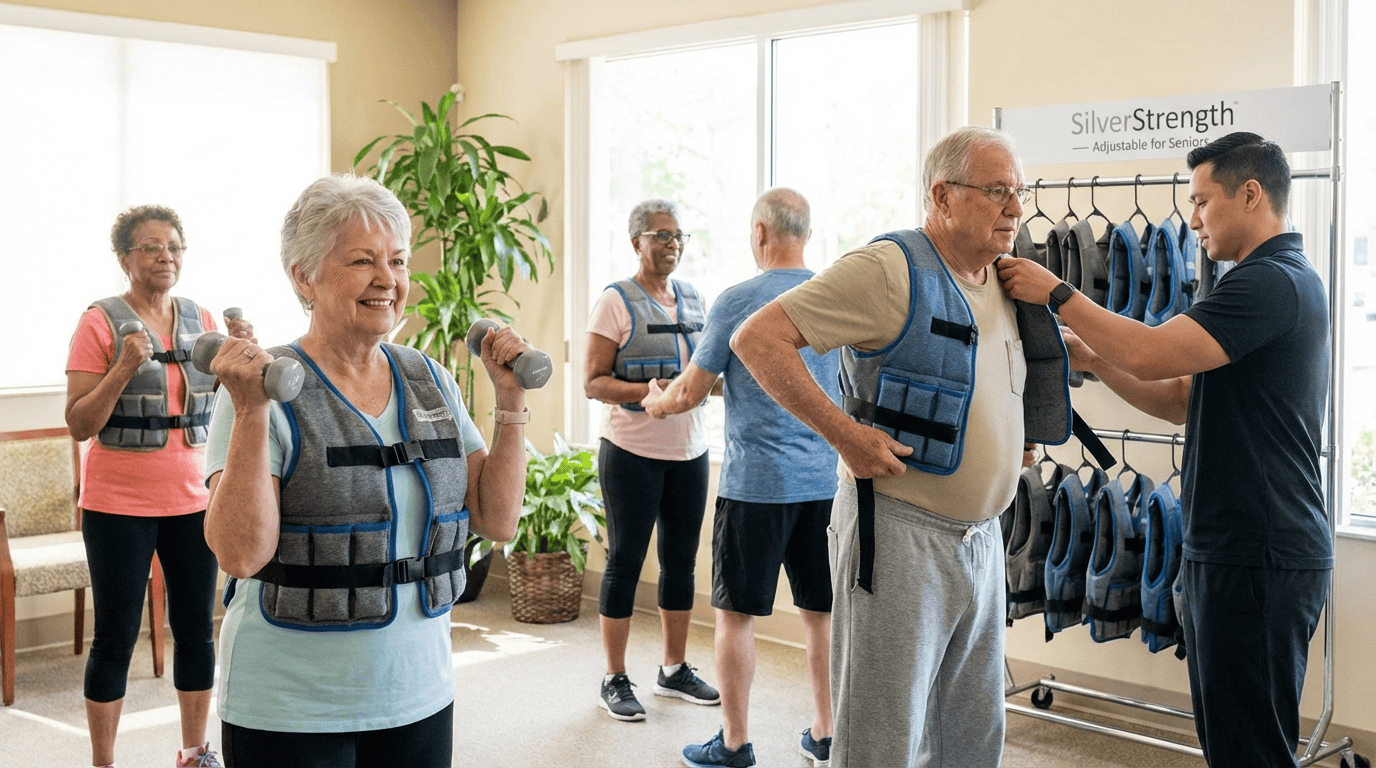
Weighted vests solve these issues by distributing load evenly across the torso while keeping hands free. This results in a more natural gait pattern, better balance, and a safer loading environment.
Evidence-Based Guidelines for Senior Loading
Based on clinical trials and biomechanical studies, these are the most senior-appropriate recommendations:
Starting Load
1–3% of bodyweight
(1–4 lbs for most people)
Progression
Increase by 0.5–1 lb every 4–6 weeks, depending on comfort.
Upper Limit
Most research participants stopped at 5–8% of bodyweight, which appears to be both safe and effective.
Frequency
3–5 days per week.
Best Activities for Bone Density with a Vest
- Brisk walking
- Stair climbing
- Sit-to-stand repetitions
- Light household chores
- Balance drills
- Gardening
A 6-Week Senior-Friendly Bone Density Program
Weeks 1–2 (Adaptation)
- Vest load: 1–2% bodyweight
- 5–10 minutes walking
- 5 sit-to-stands
- 1 staircase ascent/descent
Weeks 3–4 (Loading Phase)
- Add 0.5–1 lb to vest
- 12–15 minutes walking
- 8–10 sit-to-stands
- 2 staircases
- Optional: 1–2 minutes balance practice
Weeks 5–6 (Strength Maintenance)
- Increase load only if comfortable
- 15–20 minutes walking
- 10–12 sit-to-stands
- 3 staircases
- Short step-downs or gentle marching
This routine mirrors protocols used successfully in published trials.
Who Should Avoid Weighted Vests Initially
Weighted vests are generally safe, but seniors with the following conditions should seek medical advice first:
- Severe osteoporosis with recent vertebral or hip fractures
- Uncontrolled blood pressure
- Significant balance disorders
- Neurological gait impairments
- Advanced arthritis flare-ups
Most seniors still qualify for a modified, guided program.
Real-World Results Seniors Commonly Report
Across studies and physical therapy settings, older adults using weighted vests consistently describe:
- Feeling more stable while walking
- Standing taller with better posture
- Experiencing stronger legs
- Noticing less fatigue on daily walks
- Hearing their doctor say their bone density scores stabilized
For seniors, maintaining bone density is already a major victory.
Conclusion
Weighted vests may look simple, but the science behind them is compelling. For seniors who want to protect their bones, improve posture, strengthen their legs, and reduce fall risk, this tool delivers one of the safest, most accessible forms of mechanical loading available.
They don’t require gym memberships, heavy lifting, or complicated routines. They blend seamlessly into walking, errands, gardening, or stair climbing — the exact activities seniors already perform.
And in a world where bone loss often feels inevitable, weighted vests offer something different: a practical, research-backed way to slow that decline and preserve independence for years to come.
FAQs
Does wearing a weighted vest actually increase bone density?
Studies show weighted vests can improve or maintain bone density, particularly in the lumbar spine and hip — two major fracture sites in seniors.
How heavy should the vest be for older adults?
Start with 1–3% of bodyweight and progress slowly. Some seniors never exceed 5%, and that’s perfectly effective.
Can weighted vests help prevent falls?
Yes. Research links vest use with improved balance, proprioception, leg strength, and posture — all key fall-prevention factors.
Are weighted vests safe for someone with osteoporosis?
Mild to moderate osteoporosis often benefits from vest loading. Those with recent fractures should seek professional clearance first.
How many days per week should seniors use a weighted vest?
Three to five days per week is ideal for stimulating bone remodeling.
References
- Lau, R. et al. (2008). Weighted Vest Exercise Improves Bone Density in Postmenopausal Women. Journal of Gerontology: Medical Sciences.
- Snow, C.M., et al. (2000). Weighted Vest Resistance Training Improves Bone Mineral Density and Functional Ability in Older Women. Medicine & Science in Sports & Exercise.
- Johnson, M.J. et al. (2012). Five-Year Study of Weight-Bearing Exercise and Bone Health in Older Women. Applied Physiology, Nutrition, and Metabolism.
- Hamill, J. et al. (1995). Effect of Adding Weight on Ground Reaction Forces During Walking. Gait & Posture.
- Sherrington, C., et al. (2019). Exercise to Prevent Falls in Older Adults: A Systematic Review and Meta-analysis. Cochrane Database of Systematic Reviews.
- Kohrt, W.M., et al. (2004). Physical Activity and Bone Health in Older Adults. Journal of the American College of Sports Medicine.
- Howe, T. et al. (2011). Exercise for Preventing and Treating Osteoporosis in Postmenopausal Women. Cochrane Review.